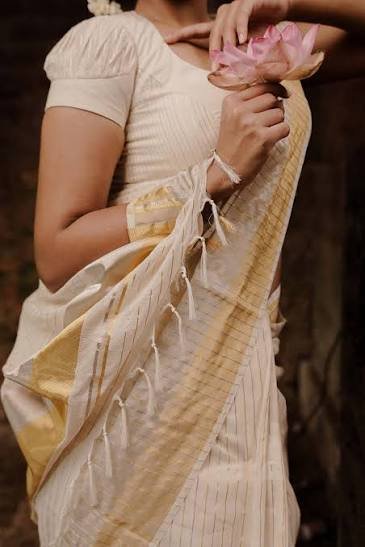

When you think of a Kanjeevaram silk saree, what is the very first thing that catches your eye? Is it the rich, heavy silk that drapes like royalty? Or is it that striking, high-contrast, lustrous border gleaming with real gold zari?
For generations, the Kanjeevaram has been the ultimate heirloom in Indian households. From weddings to grand festivals, a Kanchipuram silk saree is more than just six yards of fabric—it is an emotion, a status symbol, and a piece of living history.
But here is a fascinating historical twist that most saree lovers don’t know: the iconic, broad, motif-rich border we celebrate today didn’t just evolve overnight in the looms of Kanchipuram. Its true aesthetic soul was forged miles away in the magnificent, art-loving royal courts of Thanjavur.
The intersection of Maratha kings, Chola architectural legacies, and the migration of master weavers created a cultural melting pot that forever changed the anatomy of the Kanjeevaram border. Let’s take a journey back in time to unravel how Thanjavur royalty shaped the crown jewel of South Indian textiles.
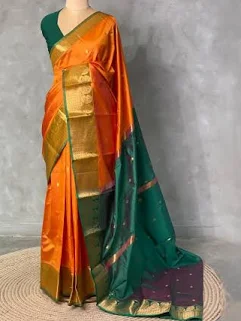
The Historical Link: Kanchipuram and the Royal Courts of Thanjavur
To understand this artistic marriage, we have to look at the geopolitical map of ancient and medieval South India. Kanchipuram was historically a city of weavers, renowned for its sturdy, high-quality silk and cotton weaving. However, the early Kanjeevaram sarees were relatively simple. They were celebrated for their durability and solid colors, but they lacked the opulent, heavily ornamented borders we see today.
Enter the royal courts of Thanjavur.
Thanjavur, the capital of the mighty Cholas and later ruled by the Thanjavur Nayaks and the Thanjavur Marathas, was the undisputed cultural capital of South India. The kings of Thanjavur weren’t just rulers; they were obsessive patrons of the arts. They funded grand temples, commissioned exquisite paintings, and demanded the finest luxuries for royal attire.
[Kanchipuram Weaving Expertise]
              +
[Thanjavur Royal Patronage & Maratha Aesthetics]
              =
[The Modern, Heavy-Zari Kanjeevaram Border]
When the Maratha rulers took control of Thanjavur in the 17th century under Venkoji (Ekoji I), they brought with them a profound love for Deccan and North Indian opulence—especially the use of pure metallic threads (zari). The royal court began inviting master weavers from Kanchipuram and Saurashtra to create garments worthy of kings and deities. This royal patronage acted as an incubator, pushing Kanchipuram weavers to elevate their craft from a local utility trade to an elite art form.
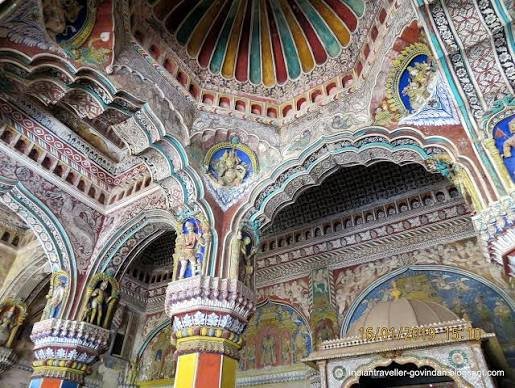
The Maratha Influence: Bringing Glitter and Gold to the Loom
Before the Maratha rule in Thanjavur, the embellishments on South Indian sarees were subtle. Threadwork was preferred over heavy metallic ornamentation. However, the Maratha royals had a taste for the theatrical and the grand. They wore heavy silks woven with real gold and silver threads, inspired by their interactions with the Mughals and the Deccan sultanates.
The Influx of Pure Zari
The Thanjavur court demanded that the Kanchipuram weavers incorporate heavy, unbroken bands of zari into the saree borders. This wasn’t just any tinsel; it was pure zari made by winding solid silver wire around a silk thread and then dipping it in 24-karat gold.
The royal court established strict quality standards for the silk and metal used, ensuring that the borders wouldn’t tarnish over time. This obsession with heavy gold borders gave birth to the Pattu culture, where the border became the defining, most expensive segment of the entire saree.
The Evolution of the Contrast Border
In the Thanjavur court, attire needed to stand out during grand durbars and candle-lit palace processions. A monochromatic saree simply wouldn’t do. The court encouraged weavers to experiment with deep, saturated contrast colors—like a parrot green body paired with a crimson border, or a brilliant mustard body paired with a royal purple edge.
To achieve this striking contrast seamlessly, weavers perfected the legendary korvai weaving technique.
Engineering the Border: The Mastery of Korvai
You cannot talk about the Kanchipuram silk saree history without bowing down to the technical genius of the Korvai technique. “Korvai” in Tamil means “to catch” or “to sync,” and it is the exact method used to attach a heavy, contrasting border to the main body of a Kanjeevaram saree.
[Saree Body (Weated by Weaver 1)] ──┐
                                   ├──► [Interlocking Petni/Korvai Joint] ──► [The Iconic Kanjeevaram Border]
[Saree Border (Woven by Weaver 2)] ──┘
Because the royal courts demanded heavy, structurally independent borders with distinct colors, a single weaver working on a standard loom couldn’t achieve the desired density. The Thanjavur court incentivized a two-weaver system:
- One weaver would operate the shuttles for the main body of the saree.
- A second weaver (often a younger apprentice or family member) would sit on the side, managing the heavy zari shuttles dedicated exclusively to the borders.
Where the body met the border, the threads were meticulously interlocked using a technique called Petni. This joint resembles a series of tiny triangles or zig-zag patterns, often referred to as the Kodi Visiri or temple top joint.
This labor-intensive process made the border incredibly strong. It meant that even if the body of the saree wore out after fifty years, the border would remain completely intact—a testament to the engineering standards demanded by royal decree.
Decoding the Visual Language: Thanjavur Motifs in the Border
The royal courts of Thanjavur did not just dictate the materials and techniques; they provided the entire visual vocabulary for the Kanjeevaram border. The motifs we see today are deeply rooted in the architecture, religion, and court life of Thanjavur.
1. Traditional Temple Borders (Gopuram and Rekku)
Thanjavur is home to the Brihadeeswarar Temple (The Big Temple), a structural masterpiece of Chola architecture. The towering Gopurams (temple spires) and the stylized triangular steps of the temple shrines were translated directly onto the looms.
Weavers created the Thazhampoo (screw-pine flower) or Rekku (spire) border—a series of sharp, majestic triangles shooting from the border into the body of the saree. It gave the wearer an architectural dignity, mirroring the sacred geometry of the royal temples.
2. The Royal Menagerie: Animals of Power and Grace
The Maratha and Nayak rulers loved symbols of power. The Kanjeevaram borders soon became canvas for auspicious, royal fauna:
- The Yali: A mythical creature part-lion, part-elephant, and part-horse, carved extensively on Thanjavur temple pillars to ward off evil. Woven into the border, it represented royal protection.
- The Simha (Lion): The ultimate symbol of Maratha majesty and sovereignty.
- The Annapakshi: The mythical swan that could separate milk from water. The Thanjavur court prized this bird as a symbol of wisdom, justice, and purity, making it a staple in pure zari motifs.
- The Mayil (Peacock): Celebrating the opulence, beauty, and festive spirit of the palace courts.
3. Everyday Royalty: Vanki and Rudraksham
The courtly lifestyle left its mark down to the smallest detail. The Vanki motif represents the inverted V-shaped armlet worn by royal dancers and queens. The Rudraksha motif, symbolizing the beads worn by royalty and saints alike, was woven as neat, repetitive circular patterns along the inner tracks of the border, providing a textural contrast to the smooth silk.
The Modern Kanjeevaram Border: A Living Royal Legacy
Today, kings and queens no longer sit on the thrones of Thanjavur, but their aesthetic blueprint rules the world of South Indian fashion. Every time an Indian bride walks down the aisle in a heavy Kanchipuram silk saree, she is wearing the design choices made by 18th-century royals.
The modern Kanjeevaram border has retained its regal identity while adapting to contemporary tastes:
- The Return of the “Big Border” (Periya Border): In recent years, there has been a massive revival of the ultra-wide, 12-to-18-inch borders that were a favorite in the Thanjavur durbars.
- Bridal Heirloom Revival: Modern designers are digging deep into the archives of the Saraswathi Mahal Library in Thanjavur to revive lost zari layouts and bring authentic historical authenticity back to the loom.
- Preserving South Indian Textile Heritage: The Geographical Indication (GI) tag for Kanchipuram silk ensures that the rigorous standards of silk density and zari purity originally enforced by royal patrons are legally protected today.
Summary & FAQ Section
Summary Table: Evolution of the Kanjeevaram Border
| Era / Patron | Core Contribution to Border | Iconic Motif / Technique Introduced |
| Early Kanchipuram (Pre-Royal) | Focus on high-quality, durable silk fabric; plain or narrow borders. | Monochromatic weaves, simple lines. |
| Thanjavur Chola & Nayak Era | Infusion of temple architecture and spiritual iconography into the weave. | Gopuram (Temple spires), Yali, and Annapakshi. |
| Thanjavur Maratha Court (17th–19th Century) | Introduction of lavish, pure gold zari; high-contrast color pairings. | Korvai interlocking technique, Vanki (armlet) patterns, ultra-wide borders. |
| Modern Era | Revival of antique royal layouts with lightweight, wearable silk bodies. | Contemporary Korvai, jumbo borders for bridal wear. |
Frequently Asked Questions (FAQs)
Q1: What makes a Kanjeevaram border different from other silk saree borders like Banarasi?
The Kanjeevaram border is distinct due to the korvai weaving technique, where the border and body are woven separately and then structurally interlocked. Banarasi sarees usually feature continuous zari woven across the entire width of the fabric. Additionally, Kanjeevaram borders feature distinct South Indian architectural and mythical motifs, such as Gopurams and Yalis, rather than Persian-inspired floral paisley (Amru) designs.
Q2: How can I identify an authentic Korvai border?
To identify an authentic Korvai border, look closely at the junction where the saree body meets the border color. You will find a distinct, slightly raised, zig-zag or stepped interlocking pattern (known as the Petni joint). If the color transition is perfectly flat, smooth, and seamless like a print, it is likely a machine-made imitation rather than a handloom masterpiece.
Q3: Why did the Maratha kings influence South Indian sarees?
When the Marathas established their rule in Thanjavur in 1676, they integrated their North/Central Indian royal aesthetics with local South Indian traditions. They had a deep affinity for gold ornamentation, rich brocades, and vibrant court textiles, which prompted them to sponsor and upscale local Kanchipuram weavers to meet royal standards.
Q4: Are modern Kanjeevaram borders made with real gold today?
Traditionally, yes—the borders used pure silver thread dipped in 24-karat gold. Today, due to skyrocketing precious metal costs, pure zari is reserved for high-end heirloom and bridal sarees. Most commercial Kanjeevarams use “tested zari” (copper-electroplated wire) or synthetic zari. Always ask for a silk-mark and genuine zari certification when purchasing an authentic heirloom.
See Also
Kanjivaram Silks with Temple Borders
The Queen of Silks: Behind the Magic of Pure Kanjivaram Silk Sarees