An authentic Ajrakh shawl is more than a beautiful piece of fabric. It represents a traditional Indian textile craft known for its intricate geometric patterns, rich colours and painstaking printing process. Originating in the wider Sindh region and flourishing in Kutch, Gujarat, Ajrakh is traditionally made using hand-carved wooden blocks and resist-dyeing techniques. However, colours and patterns alone cannot prove authenticity. Knowing what to look for can help you make a more informed purchase.
If you love Indian handloom textiles, ethnic wear or handcrafted accessories, this guide will help you understand Ajrakh printing, recognise its traditional characteristics and choose a shawl with confidence.
What Is an Ajrakh Shawl?
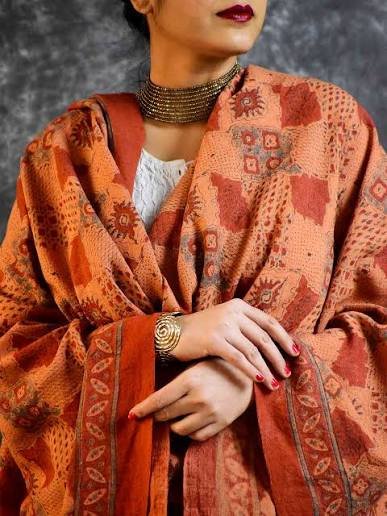
Ajrakh is a traditional textile-printing craft associated particularly with Kutch in Gujarat and Sindh. It is famous for its elaborate geometric patterns, repeating motifs and distinctive combination of indigo blue, deep red, black and white.
Traditionally, artisans print Ajrakh fabric using carved wooden blocks and a technique called resist printing. In this process, selected areas of the cloth are protected from particular dyes so that the final design develops through contrasting colours. Repeated printing, dyeing and washing create the characteristic layered appearance.
The craft has a long history in the communities of Kutch, where Ajrakh cloth was traditionally worn by pastoral communities and used for garments such as turbans and wraps. Today, the same design tradition appears in shawls, stoles, sarees, dupattas, kurtas and contemporary fashion accessories.
Ajrakh is especially valued for the skill involved in aligning its intricate patterns and building up the colours. Traditional production can require numerous stages of preparation, printing, dyeing and washing. The exact process varies between artisans and workshops.
It is also important to understand that Ajrakh is a printing tradition, not a single fixed fabric composition. Although cotton is traditional and widely used, contemporary products may use other fabrics and modified processes.
What Are the Main Characteristics of Ajrakh Printing?
Before buying an Ajrakh shawl, look beyond its overall colour and design. Understanding the craft’s characteristic features will help you ask better questions and assess the product more carefully.
1. Geometric Patterns and Repeated Motifs
One of the most recognisable features of traditional Ajrakh is its intricate geometric patterning.
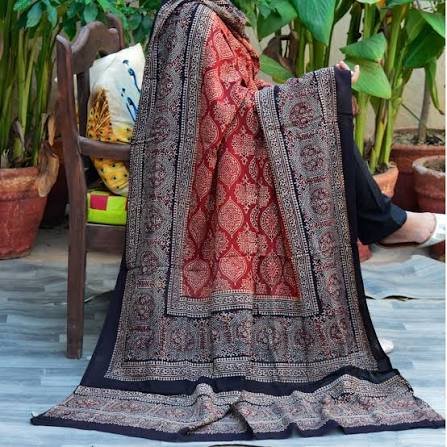
Look closely at the fabric. You may notice repeating stars, diamonds, grids, floral forms, small circular motifs and interconnected shapes. These elements are arranged carefully to create a balanced design across the cloth.
The central pattern is often framed by decorative borders. The borders may contain several rows of smaller motifs, creating a detailed frame around the main design.
Here are a few characteristics worth noticing:
- Repetition: Similar motifs appear at regular intervals across the fabric.
- Symmetry: Many designs use balanced arrangements of geometric shapes.
- Layering: Several colours and pattern elements combine to create visual depth.
- Detailed borders: The edges often have intricate designs that complement the central pattern.
In traditional hand block printing, different carved blocks may be needed to create the outlines, colours and individual elements of a design.
Buying tip: Examine the motifs closely, especially around the borders and where the pattern repeats. Neat alignment and consistent design are useful signs of skilled workmanship, but they do not independently prove that a shawl is handmade.
2. Indigo, Madder-Inspired Reds and Other Colours
The traditional Ajrakh colour palette is another defining feature.
Deep indigo blue and rich red are particularly characteristic, often appearing alongside black, white and earthy shades. These colours create the contrast that makes traditional Ajrakh patterns so distinctive.
Historically, artisans have used dyes and materials derived from natural sources. Indigo provides blue shades, while madder and related dyeing materials have been used to produce reds. Other ingredients and dyeing methods contribute to black and additional earthy tones.
However, not every Ajrakh shawl sold today is made entirely with natural dyes. Some contemporary producers use synthetic dyes or combine traditional and modern processes.
Therefore, do not assume that a shawl is authentic simply because it has dark blue and red colours. Nor should you dismiss a contemporary Ajrakh textile solely because its palette differs from the traditional combination.
If natural dyes matter to you, ask the seller specifically about the dye materials used, whether the dyes are natural or synthetic, and whether the claim applies to every colour in the design.
3. Fabric, Printing and Dyeing Processes
The production process offers some of the most useful clues when evaluating an Ajrakh shawl.
Traditional Ajrakh printing involves several stages, which may include washing and preparing the fabric, treating it with mordants, applying resist paste, printing patterns, dyeing, washing and drying.
A mordant is a substance used to help certain dyes bond with the fabric. Resist paste protects selected areas from absorbing particular dyes, allowing the intended design to emerge.
Artisans use hand-carved wooden blocks to transfer patterns onto the cloth. Multiple blocks may be required for a single design, and careful alignment is essential.
Traditional Ajrakh is also known for printing on both sides of the fabric. In a well-executed piece, the design can appear on both faces rather than looking like a surface image printed only on the front. The degree of similarity between the two sides can vary with the particular product and process.
When inspecting a shawl, look at:
- The appearance of the design on the reverse side.
- The alignment of motifs and borders.
- The clarity of the printed details.
- The fabric’s feel, weight and suitability for the intended use.
Remember that contemporary Ajrakh-inspired products may use different printing methods. The construction and manufacturing method should be considered alongside the design.
Hand-Printed Ajrakh vs Machine-Printed Lookalikes
Not every fabric featuring traditional Ajrakh motifs has been made using traditional hand block printing. Machine printing and digital printing can reproduce similar patterns, sometimes at a lower price.
Neither the use of machinery nor a modern dye automatically makes a textile unattractive or unsuitable. The important distinction is whether the product is accurately described and priced according to its production method.
Here is a quick comparison to help you understand the differences.
| Feature | Traditional hand block-printed Ajrakh | Machine-printed or digitally printed lookalike |
|---|---|---|
| Printing method | Carved wooden blocks applied by hand | Mechanical or digital printing process |
| Pattern alignment | May show small variations from hand placement | Often highly uniform |
| Design details | Built through multiple printing stages | Can reproduce detailed designs in a single or fewer stages |
| Reverse side | Traditional techniques can produce substantial patterning on both sides | May have a much lighter or different-looking reverse, depending on the process |
| Dyeing | May use traditional natural and mineral-based dyes | May use synthetic dyes or other modern printing systems |
| Production time | Traditional processes can be labour-intensive and time-consuming | Often faster and more scalable |
| Price | Depends on labour, materials, complexity and provenance | Often lower for mass-produced designs, but not always |
Can you identify genuine Ajrakh by looking at it?
Not with complete certainty. Small variations, intricate patterns and a richly coloured reverse can provide useful clues, but machine processes can reproduce some of these features. Likewise, skilled hand block printing can be highly precise.
The strongest assessment combines visual inspection with information about the artisan, production method, fabric, dyes and seller’s claims.
How to Check an Ajrakh Shawl Before Buying: 5-Point Checklist
Whether you are shopping online or visiting a textile store, use these five checks before making a purchase.
1. Inspect the Pattern and Borders
Examine the repeated motifs and the way the borders meet the central design. Traditional Ajrakh often features intricate geometric arrangements and carefully coordinated borders.
Small variations may occur in hand printing, but uneven workmanship is not proof of authenticity. Look at the overall quality and consistency of the design.
2. Check Both Sides of the Fabric
Turn the shawl over and inspect the reverse. Traditional Ajrakh is known for printing on both sides, so the pattern often remains visible on the back.
However, the reverse may not look identical to the front in every product. Ask the seller whether the particular shawl was printed on both sides and how the printing was carried out.
3. Ask About the Printing Technique and Dyes
A trustworthy seller should be able to explain whether the shawl was hand block-printed, screen-printed or digitally printed.
If natural dyes are advertised, ask which dyes were used. Avoid relying on colour, smell or touch alone to determine whether a dye is natural.
4. Check the Fabric and Finishing
Look at the fabric composition, stitching, edges and overall finish. Cotton is a traditional choice, but other materials are also used in contemporary Ajrakh products.
Check whether the shawl feels appropriate for your intended use. A lightweight cotton wrap, for example, will behave differently from a heavier textile.
5. Verify the Seller and Product Information
Buy from sellers who provide clear descriptions, photographs and information about the craftsperson or production location.
For a product marketed as traditional Kutch Ajrakh, ask whether its origin can be documented. Relevant geographical indication information, where applicable, may help establish provenance. A GI claim should be supported by appropriate documentation rather than a seller’s unsupported statement.
Quick takeaway: Check the pattern, reverse side, printing method, fabric and seller’s information together. No single visual feature can guarantee authenticity.
What Affects the Price of an Ajrakh Shawl?
The price of an Ajrakh shawl depends on more than its appearance. Two pieces with similar patterns may have different prices because their materials, production methods and workmanship differ.
Here are the main factors to consider.
1. Printing technique: Traditional hand block printing requires skilled labour, careful alignment and multiple stages. Machine-printed alternatives can often be produced more quickly.
2. Dye materials: Natural dyes and the preparation they require may affect the cost. However, a higher price alone does not establish that natural dyes were used.
3. Fabric quality: Fibre composition, fabric weight, weaving quality and finishing all influence the final product.
4. Design complexity: Intricate patterns requiring several blocks and multiple printing stages may involve more work than simpler designs.
5. Size and workmanship: A larger shawl or one with detailed borders may require more fabric, printing time and labour.
6. Artisan and seller provenance: Buying directly from a craftsperson or a transparent craft enterprise can provide better information about the product’s origin and production.
Rather than judging a shawl by price alone, compare its specifications and ask what makes the product different. A costly piece is not automatically authentic, and an affordable piece is not automatically machine-made.
How to Care for an Ajrakh Shawl
Good care helps preserve the colours and appearance of your textile. The right method depends on the fabric, dye system and finishing, so always follow the seller’s instructions.
- Check the care label: Confirm the fabric composition and recommended washing method.
- Be cautious with the first wash: Some textiles may release excess dye, especially during early washes. Ask the seller whether separate washing is recommended.
- Use a gentle washing method: If the care instructions permit hand washing, use cool water and a mild detergent.
- Avoid harsh chemicals: Bleach and aggressive cleaning products can damage fibres and affect colours.
- Dry carefully: Follow the garment’s instructions. Avoid prolonged exposure to strong sunlight if it may cause fading.
- Store it properly: Keep the shawl clean and dry, away from dampness and direct sunlight.
Do not assume that every natural-dyed textile requires exactly the same care. When in doubt, seek advice from the maker or a textile-care professional.
Frequently Asked Questions About Ajrakh Shawls
What makes an Ajrakh shawl authentic?
An authentic traditional Ajrakh shawl is produced using the characteristic Ajrakh textile-printing tradition, generally involving resist techniques and carefully aligned patterns. Details such as the reverse-side print, design, materials and production method can help, but the seller’s information and provenance are also important.
Is all Ajrakh printing done by hand?
No. Traditional Ajrakh is associated with hand block printing, but contemporary products may use machine-assisted, screen-printing or digital methods. Check how the particular shawl was produced instead of assuming that every Ajrakh-style print is handmade.
Are all authentic Ajrakh shawls made with natural dyes?
Not necessarily. Natural dyes are an important part of traditional Ajrakh practice, but modern production may use synthetic dyes or a combination of materials. Ask the seller for specific information about the dyes used in the product.
Why is Ajrakh usually associated with blue and red?
Indigo has traditionally been an important source of blue, while madder and related dye materials have been used for red. These colours, combined with black, white and geometric motifs, are characteristic of many traditional Ajrakh textiles.
Is Ajrakh the same as ordinary block printing?
Ajrakh is a particular textile-printing tradition, not simply another name for all block printing. It is distinguished by its characteristic designs and, in traditional practice, a complex sequence of resist printing, dyeing and washing.
How can I buy an Ajrakh shawl online with confidence?
Look for clear photographs of both sides, the fabric composition, printing method, dye information and details about the artisan or place of production. Check the seller’s return policy and ask questions if the description is unclear.
Where does traditional Ajrakh come from?
Ajrakh has historical connections with Sindh and is strongly associated with Kutch in Gujarat, where artisan communities continue to practise and develop the craft.
Final Thoughts
An Ajrakh shawl can bring together intricate geometry, traditional dyeing knowledge and the skill of Indian textile artisans. Learning to recognise its characteristic patterns and printing methods makes shopping more rewarding and helps you appreciate the work behind each piece.
The most important lesson is simple: do not judge authenticity by colour or appearance alone. Look at both sides, understand the printing process, ask about the dyes and fabric, and choose sellers who can explain where and how their textiles are made.
When you buy with this knowledge, you are better equipped to choose a shawl that suits your needs while appreciating the craft traditions behind it.
See Also
- District Kachchh, Government of Gujarat — Handicrafts — regional context and Ajrakh characteristics.
- Government of India — Kutch Ajrakh — traditional materials, tools and production processes.
- Ajrakh Printing — Government of Rajasthan — printing methods, dyes and design characteristics
- Mekhela Chador vs Saree: Difference, Draping and When to Wear Each
- Earth, Water, and Indigo: The Magic of Traditional Ajrakh Block Printing
- The Heritage Weave: History and Evolution of the Traditional Kashmiri Jamawar