India’s handloom traditions are full of beautiful textiles, but some sarees stand out for their understated elegance rather than heavy decoration. The Maheshwari saree is one such example.
Whether you are shopping for a comfortable office saree, an elegant festive outfit or a traditional handloom piece, understanding Maheshwari saree features can help you make a better choice.
But what makes a Maheshwari saree special? Is it made from pure silk or cotton? How is it different from a Chanderi saree? And most importantly, how can you identify an original Maheshwari saree when shopping online or in a textile market?
This guide answers these questions and explains the fabric, weaving, borders, motifs and practical buying considerations.
What Is a Maheshwari Saree?
A Maheshwari saree is a traditional woven textile associated with Maheshwar, a historic town on the banks of the River Narmada in Madhya Pradesh.
The characteristic Maheshwari saree features include elegant geometric borders, striped or checked designs, distinctive pallus, and silk-cotton or other fibre variations. Traditional examples are appreciated for their balanced combination of simplicity, lustre and comfortable draping.
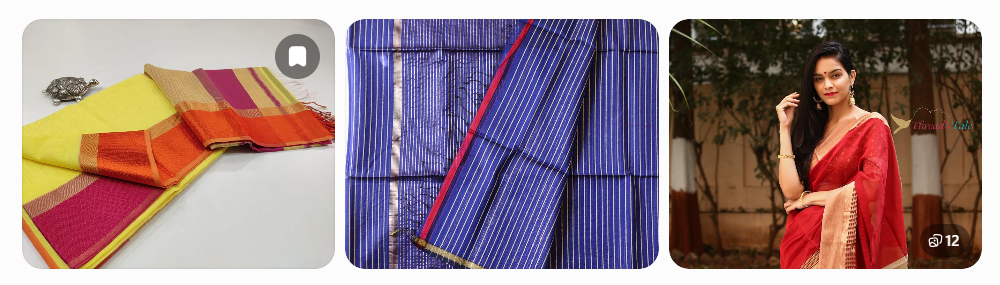
The weaving tradition is closely associated with Maharani Ahilyabai Holkar, the 18th-century ruler of the Holkar kingdom. According to local textile history, she encouraged skilled weavers to settle in Maheshwar and supported the development of its weaving industry.
The fort, temples, architectural carvings and natural surroundings of Maheshwar influenced many traditional designs. Over time, the sarees became known for their graceful borders and distinctive weaving patterns.
Today, Maheshwari sarees are worn for office functions, religious occasions, family celebrations, festivals and everyday outings.
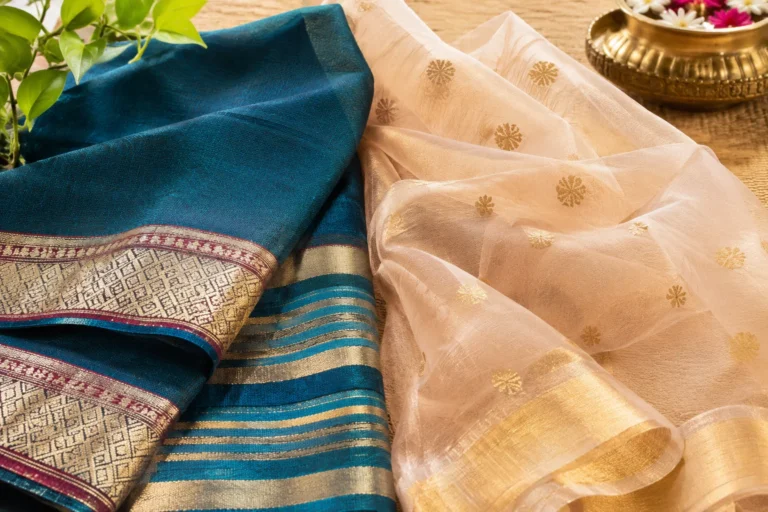
Maheswari and Chanderi, both are from Madhya Pradesh – however, there’s several key differences between Maheswari saree and Chanderi saree
Why are Maheshwari sarees famous?
Their popularity comes from a combination of practical and aesthetic qualities.
- Comfortable fabric: Many cotton and silk-cotton varieties are relatively lightweight and suitable for Indian weather.
- Distinctive borders: Traditional geometric designs are important identifying features.
- Elegant appearance: A plain or subtly patterned body often balances a decorative border and pallu.
- Versatile styling: Different fabric compositions work for both formal and casual occasions.
- Traditional craftsmanship: Handwoven Maheshwari textiles represent a regional weaving heritage.
Maheshwar Sarees & Fabrics also holds a registered Geographical Indication (GI), recognising its association with Madhya Pradesh.
What Fabric Is Used to Make Maheshwari Sarees?
One common question among buyers is whether a Maheshwari saree is made from silk or cotton.
The answer is that Maheshwari saree fabric is available in different compositions, including cotton, silk-cotton blends and silk varieties.
Understanding these variations is important because the fibre composition affects the saree’s texture, sheen, drape, comfort, care and price.
1. Silk-cotton Maheshwari sarees
Silk-cotton is among the most recognisable Maheshwari fabric combinations.
In a traditional construction, silk yarn is used in the warp (the lengthwise threads), while cotton yarn forms the weft (the crosswise threads).
This combination creates a fabric that balances the lustre of silk with some of the comfort and character of cotton.
A silk-cotton Maheshwari saree generally offers a graceful drape, moderate sheen and a relatively compact weave compared with the more transparent Chanderi fabric.
It is a popular choice for office events, pujas, daytime celebrations and festive gatherings.
2. Pure cotton Maheshwari sarees
Cotton has an important place in the history of Maheshwari weaving.
Traditional cotton sarees are valued for their comfort, particularly in warm weather.
Depending on the yarn and weave, a cotton Maheshwari saree may have a softer, more matte appearance than its silk-cotton counterpart.
These sarees can be suitable for daily wear, summer outings, workplace dressing and informal family functions.
However, cotton does not automatically mean that a saree is handwoven. Always check the manufacturing details.
3. Silk Maheshwari sarees
Silk-rich Maheshwari sarees generally have a more pronounced lustre and a dressier appearance.
They may be preferred for weddings, festive dinners and traditional celebrations, especially when combined with decorative borders or zari.
The term silk Maheshwari does not always describe one standard fabric composition. Ask the seller whether the saree uses silk in both warp and weft or contains other fibres.
4. Contemporary Maheshwari fabric variations
Modern weavers and manufacturers also produce Maheshwari-style textiles in different yarn combinations, finishes and weights.
Some may use mercerised cotton, blended yarns or decorative metallic threads.
For this reason, fabric names such as pure silk, silk cotton and handloom Maheshwari should be supported by clear product specifications rather than accepted purely as marketing descriptions.
Traditional and contemporary fabric variations are documented by the Khargone district administration and India’s handloom references. India+2
What Makes the Maheshwari Saree Border Distinctive?
Among the most important Maheshwari saree features is its border.
Unlike sarees dominated by elaborate decoration across the entire body, traditional Maheshwari designs often concentrate visual detail along the borders and pallu.
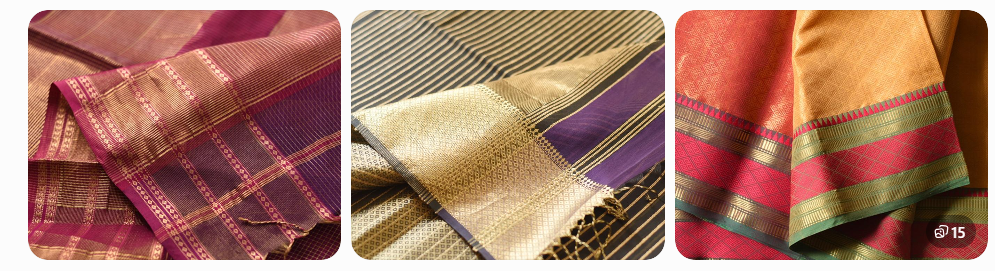
The traditional reversible border
A distinctive element of Maheshwari weaving is the reversible border, traditionally known as bugdi.
In this style, the design looks similar on both sides of the border.
This was a practical as well as decorative characteristic because the textile could be worn without the border having an obviously different front and reverse.
However, not every modern saree sold as Maheshwari will have a fully reversible border.
Therefore, reversibility is a useful identification clue, not a compulsory test for every contemporary design.
Zari and contrasting colours
Traditional Maheshwari borders may incorporate zari, contrasting coloured yarns and carefully arranged geometric designs.
You might find a cream saree with a maroon border, a green saree with gold detailing or a deep blue saree with subtle metallic stripes.
The contrast between the body and border often creates the saree’s distinctive appearance.
The characteristic striped pallu
Another recognisable feature is the decorative pallu, or aanchal.
Traditional Maheshwari pallus frequently include a combination of broad and narrow stripes.
The five-stripe arrangement is particularly associated with the heritage design, although contemporary sarees may use other arrangements.
These details are well documented in textile studies and Madhya Pradesh Tourism’s description of Maheshwari weaving. Census India+1
Common Maheshwari Saree Motifs and Designs
Maheshwari saree motifs reflect the architectural and natural surroundings of Maheshwar.
Unlike heavily ornamental textiles, many traditional designs emphasise repetition, geometry and balance.
Here are some patterns worth knowing.
Heera – Diamond pattern : The heera design uses diamond-shaped geometry. It is especially attractive in borders, where repeated shapes create a neat, symmetrical appearance.
Chatai – Mat-inspired design : Inspired by the interlaced structure of woven mats, the chatai pattern uses ordered geometric arrangements that complement the saree’s relatively simple body.
Chameli Ka Phool – Jasmine motif : The jasmine-inspired motif introduces a floral element while maintaining the structured design character associated with traditional Maheshwari textiles.
Other recognisable designs include rui phool, inspired by the cotton flower, and leheriya, associated with wave-like patterns.
Traditional stripes and checks are also important. In many Maheshwari sarees, the main body remains relatively plain, allowing the borders and pallu to stand out.
The Ministry of Textiles documents chatai, heera and chameli ka phool among traditional designs, with architectural details of Maheshwar Fort serving as a major inspiration. ministryoftextiles.gov.in+1
Traditional versus modern Maheshwari designs
Traditional Maheshwari sarees generally emphasise restrained patterns and borders.
Modern collections may experiment with brighter colours, broader borders, additional motifs and contemporary styling.
Neither approach is automatically better. Buyers who value traditional weaving details may prefer heritage patterns, while those seeking everyday fashion versatility might choose newer designs.
The important distinction is between a genuine product made in the relevant weaving tradition and an imitation that merely borrows its visual appearance.
Maheshwari vs Chanderi vs Banarasi Sarees
Indian saree buyers frequently compare Maheshwari, Chanderi and Banarasi textiles.
Although all three are celebrated Indian weaving traditions, they have different origins and characteristic textile structures.
Maheshwari vs Chanderi vs Banarasi: Comparison table
| Feature | Maheshwari saree | Chanderi saree | Banarasi saree |
|---|---|---|---|
| Origin | Maheshwar, Madhya Pradesh | Chanderi, Madhya Pradesh | Varanasi, Uttar Pradesh |
| Fabric | Traditionally cotton and silk-cotton; silk variations | Cotton, silk and silk-cotton | Traditionally silk, especially in brocade varieties; other variations exist |
| Texture | Generally compact, smooth and comfortable | Often lighter, finer and more sheer | Often richer and heavier in elaborate brocade varieties |
| Design | Geometric borders, stripes, checks and distinctive pallus | Delicate motifs, buttis and subtle zari work | Elaborate brocade, floral motifs and prominent zari |
| Typical use | Office wear, pujas, festive and everyday occasions | Daytime celebrations, parties and festivals | Weddings, formal celebrations and festive occasions |
These are typical characteristics rather than universal rules. Modern collections can differ significantly in construction, weight and ornamentation. National Handloom+2
Maheshwari vs Chanderi: Which is better?
Both originate in Madhya Pradesh, but their appearance and feel differ.
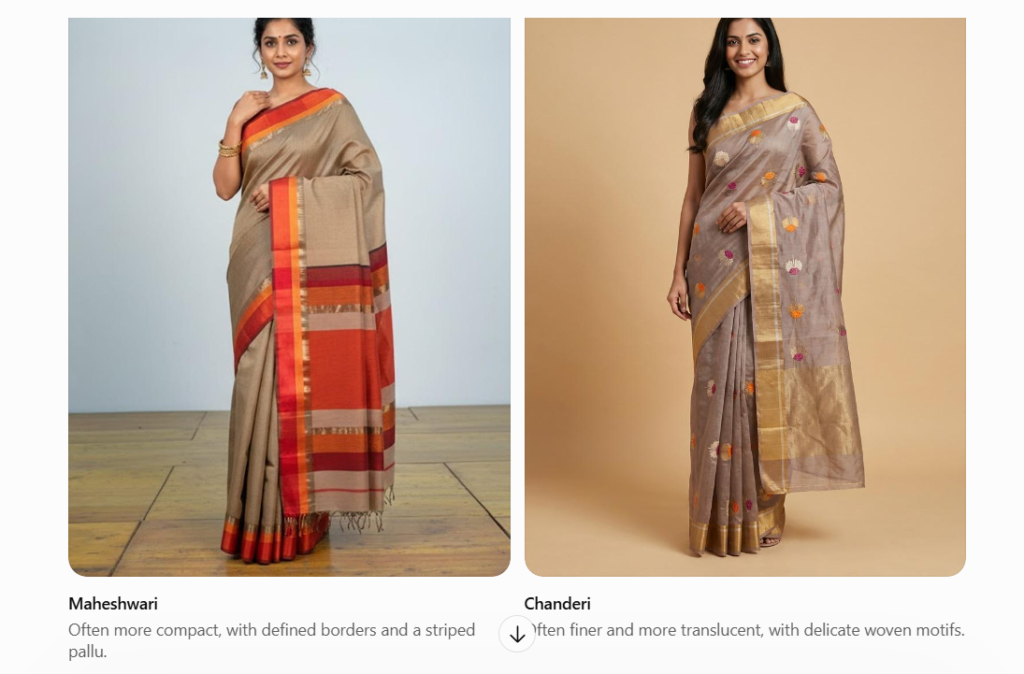
Choose a Maheshwari saree if you prefer a relatively structured drape, distinctive borders and versatile styling.
Choose Chanderi if you enjoy a more translucent fabric and delicate ornamental detailing.
The right choice depends on the particular saree’s composition and your preferred look.
Maheshwari vs Banarasi: Which should you buy?
Dark Red Pure Silk Cotton Woven Maheswari Saree | Taneira Online Store
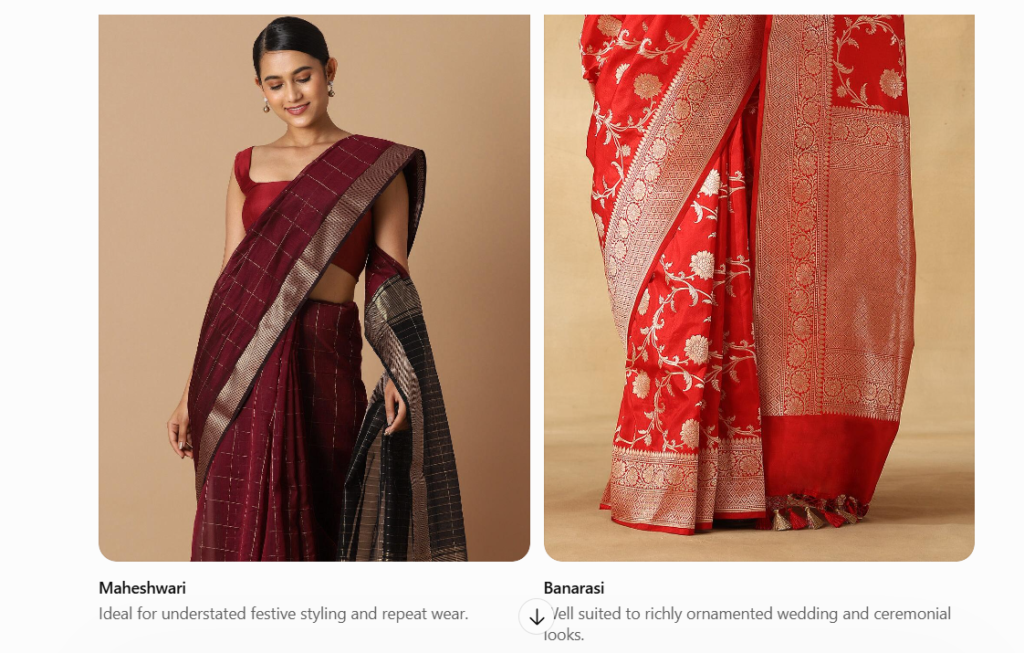
If you want a saree for an intimate family function or an elegant office celebration, a Maheshwari silk-cotton saree may be a practical choice.
For a grand wedding look, an elaborate Banarasi brocade might be more appropriate.
However, some silk Maheshwari sarees can also look sufficiently rich for weddings, while lighter Banarasi varieties are available for less formal occasions.
How to Identify a Maheshwari Saree When Shopping
Knowing the traditional Maheshwari saree features is helpful, but identifying an original handwoven product requires more than examining the colour or pattern.
A seller may use the term Maheshwari for products with similar-looking borders, even when their manufacturing origin or fibre composition differs.
Here are the most useful checks.
1. Examine the border closely
Look for geometric designs, repeated patterns, contrasting colours and traditionally inspired woven details.
If the saree has a reversible border, compare both sides to see whether the design appears similar.
Remember that not every genuine contemporary Maheshwari saree must have this characteristic.
2. Check the pallu design
Traditional designs often feature broad and narrow stripes on the pallu.
A five-stripe arrangement can be a helpful clue, although its absence does not automatically make a saree inauthentic.
3. Understand the fabric composition
A silk-cotton Maheshwari saree may have a gentle sheen and a more compact feel than some fine Chanderi fabrics.
Nevertheless, touch and visual appearance alone cannot reliably establish fibre content.
Read the product description and ask whether the saree is cotton, silk-cotton, pure silk or another blend.
4. Ask whether it is handloom or powerloom
This is particularly important when purchasing an expensive saree.
Handloom refers to fabric woven on a manually operated loom, while powerloom fabric is produced using a mechanically powered loom.
Small weaving variations may occur in handloom products, but irregularities are not conclusive proof of handweaving.
A perfectly even-looking fabric is not necessarily machine-made either.
5. Look for reliable labels and documentation
For products marketed as genuine handloom, check for credible supporting information.
India’s Handloom Mark and India Handloom Brand are useful certification or branding references where applicable.
Ask the seller about the weaving centre, manufacturer or weaver group.
Since Maheshwar Sarees & Fabrics is GI registered, verifiable information about the product’s geographical origin also matters.
A GI registration does not mean that every saree described as Maheshwari is automatically verified or that any ordinary tag proves authenticity. Intellectual Property India+1
6. Compare the price with the product details
Handwoven sarees may cost more because weaving involves skilled labour and time.
However, a high price does not guarantee authenticity, and an affordable price does not automatically indicate a fake.
Compare similar sarees based on fabric, weaving method, design complexity, finishing and seller credibility.
7. Check the seller’s return policy
When buying Maheshwari sarees online, examine the available product photographs carefully.
Look for close-up images of the border, pallu and fabric surface.
Also confirm the saree length, blouse-piece inclusion, shipping charges and return conditions before ordering.
Quick buying tip: A combination of documented Maheshwar origin, accurate fibre disclosure, credible handloom information and recognisable weaving details offers stronger evidence than any single visual test.
How to Style and Care for a Maheshwari Saree
One of the biggest advantages of Maheshwari sarees is their versatility.
Depending on the fabric and border, the same weaving tradition can offer simple everyday designs and elegant festive outfits.
Maheshwari saree blouse combinations
A blouse can completely change the appearance of a saree.
For office wear, pair a cotton Maheshwari saree with a simple matching blouse or a high-neck design.
For family functions, choose a contrasting silk blouse that complements the border.
For festive occasions, a sleeveless, elbow-length or boat-neck blouse can work beautifully, depending on your preferred style.
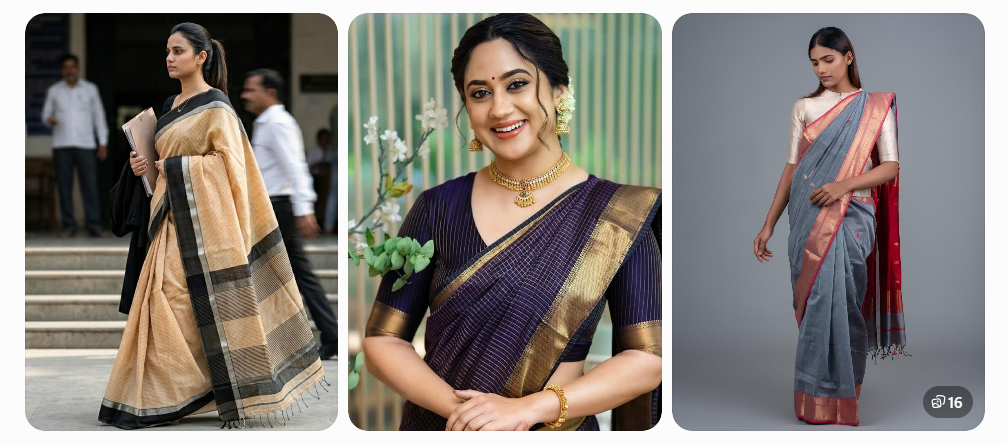
Jewellery and accessories
Maheshwari sarees work well with both traditional and contemporary accessories.
Oxidised silver jewellery can complement cotton sarees, while gold-toned earrings or a delicate necklace may suit silk-cotton varieties with zari borders.
For a classic Indian look, try a small bindi, traditional jhumkas and a neatly tied bun.
For contemporary styling, minimal jewellery, a structured handbag and simple sandals can create an equally attractive outfit.
How to wash and maintain a Maheshwari saree
Proper care depends on the fabric composition, colour fastness and decorative work.
For silk-rich or zari-heavy sarees, professional dry cleaning is generally the safer choice unless the manufacturer recommends another method.
For washable cotton Maheshwari sarees, consider these precautions:
- Use a mild detergent and cool water, following the care label.
- Avoid vigorous rubbing, wringing or prolonged soaking.
- Dry in the shade to reduce unnecessary colour fading.
- Iron at a temperature suitable for the stated fibre composition.
- Store completely dry in a clean, breathable fabric cover.
Silk and zari sarees should be stored carefully, preferably away from prolonged direct sunlight and moisture.
Refolding occasionally can also help avoid maintaining sharp creases in the same places for extended periods.
Frequently Asked Questions About Maheshwari Sarees
1. What are the main characteristics of a Maheshwari saree?
The main Maheshwari saree features include traditional geometric borders, striped or checked designs, distinctive pallus, and cotton, silk-cotton or silk fabric variations. The reversible bugdi border is an important heritage characteristic.
2. Is a Maheshwari saree pure silk or cotton?
Maheshwari sarees are available in different fibre compositions. Traditional and contemporary varieties include cotton, silk-cotton and silk. Always check the exact material description before purchasing.
3. How can I identify an original Maheshwari saree?
Examine the woven border, pallu, texture and design details. More importantly, check the seller’s information about the weaving origin, fibre composition and handloom production. No single visual feature guarantees authenticity.
4. What is special about the Maheshwari saree border?
The traditional reversible border, known as bugdi, is especially associated with Maheshwari weaving. Geometric motifs, contrast colours and zari detailing are other recognisable characteristics.
5. What is the difference between Maheshwari and Chanderi sarees?
Maheshwari sarees generally have a more compact weave, distinctive borders and striped pallus. Chanderi sarees are often finer, lighter and more translucent, with delicate motifs or buttis.
6. Can Maheshwari sarees be worn in summer?
Yes. Cotton and many silk-cotton Maheshwari sarees can be comfortable in warm weather. Breathability and comfort depend on the fibre composition, weave density and finishing.
7. Are Maheshwari sarees suitable for weddings?
Yes. Silk-rich Maheshwari sarees with decorative zari borders can be styled for weddings, engagement ceremonies and festive occasions. Their appearance is generally more understated than heavily brocaded wedding sarees.
8. Are all Maheshwari sarees handwoven?
No. Products marketed using the Maheshwari name may include handwoven textiles, machine-made imitations or Maheshwari-inspired designs. Ask for reliable details about the manufacturing method and origin.
9. Does a genuine Maheshwari saree have a GI tag?
Maheshwar Sarees & Fabrics is a registered GI product. However, GI registration does not mean every saree sold under the name has been individually authenticated. Verify the seller’s origin claims and any supporting documentation.
10. Why should I buy a Maheshwari handloom saree?
A genuine handwoven Maheshwari saree combines regional craftsmanship, versatile design and textile heritage. Buying from trustworthy weavers, cooperatives or retailers can also help sustain the traditional weaving industry.
Final Thoughts: Why Maheshwari Sarees Deserve a Place in Your Wardrobe
The beauty of a Maheshwari saree lies in its balance between simplicity and craftsmanship.
From its characteristic borders and striped pallus to its varied fabric compositions, every element reflects a weaving tradition shaped by the cultural heritage of Maheshwar.
Understanding Maheshwari saree features helps you look beyond attractive product photographs and make an informed buying decision.
Whether you prefer an everyday cotton saree or a silk-cotton piece for special occasions, focus on fabric quality, weaving details, authentic origin information and your personal comfort.
A thoughtfully chosen Maheshwari saree is not merely another addition to your ethnic wardrobe. It is also an opportunity to appreciate one of India’s distinctive textile traditions.
See Also
- Khargone District Administration – Maheshwari Saari
- Intellectual Property India – Maheshwar Sarees & Fabrics GI
- The Weaving Story of Maheshwari Saris – Madhya Pradesh Tourism
- Maheshwari vs Chanderi Saree: 7 Key Differences in Fabric, Texture and Style
- Kota Doria vs Chanderi: Which Fabric Is Better for Summer?
- Tant vs Jamdani Saree: Difference in Weave, Weight and Occasion
- Linen Saree vs Cotton Saree: Which Is Better for Indian Summers?