When shopping for a traditional Indian saree, two beautiful names often come up: Maheshwari and Chanderi. Both come from Madhya Pradesh, both are known for elegant handloom craftsmanship, and both are popular among women who appreciate lightweight, graceful ethnic wear.
But if you are comparing a Maheshwari vs Chanderi saree, which one should you choose?
Although they may look similar at first glance, these sarees have important differences in weaving, fabric texture, transparency, borders and traditional motifs.
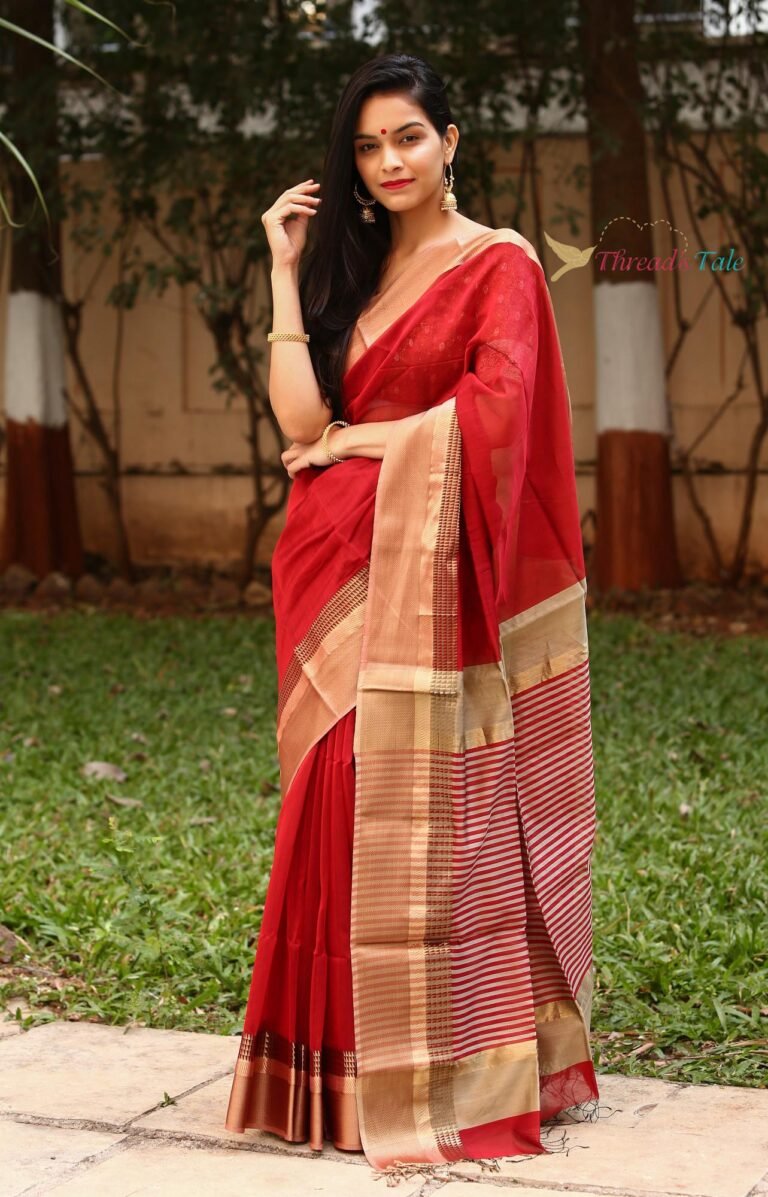
The main difference between Maheshwari and Chanderi sarees is their typical fabric structure and design. Maheshwari sarees generally have a more compact weave, geometric borders and striped pallus, while Chanderi sarees are known for their fine, often translucent fabric, delicate motifs and subtle sheen.
Both weaving traditions offer cotton, silk-cotton and silk variations, so the exact feel depends on the individual product.
In this guide, we compare their characteristics, explain how to identify them, and help you decide which saree suits your wardrobe, occasion and budget.
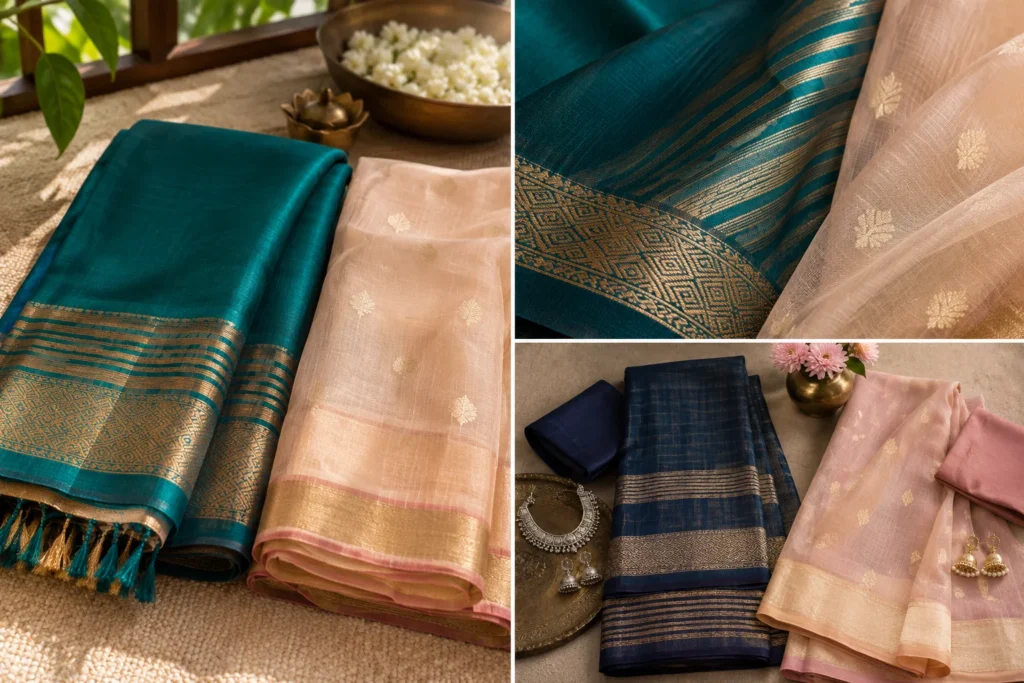
What Is the Difference Between Maheshwari and Chanderi Sarees?
Before discussing the individual features, here is a quick comparison for anyone choosing between these traditional Indian handloom sarees.
Maheshwari vs Chanderi Saree Comparison Table
| Feature | Maheshwari Saree | Chanderi Saree |
|---|---|---|
| Origin | Maheshwar, Madhya Pradesh | Chanderi, Madhya Pradesh |
| Traditional fabric | Cotton and silk-cotton, with other variations | Cotton, silk-cotton and silk |
| Texture | Generally more compact and structured | Generally finer, lighter and more sheer |
| Transparency | Usually less transparent in comparable constructions | Often noticeably translucent |
| Design | Geometric borders, checks and stripes | Delicate buttis, floral and nature-inspired motifs |
| Border and pallu | Reversible border tradition and striped pallu | Fine borders, zari and decorative pallu motifs |
| Typical use | Office wear, pujas, everyday elegance | Festivals, celebrations and dressy daytime events |
| Draping | Often offers a defined, neat silhouette | Often produces a softer, more delicate-looking drape |
These are characteristic differences, not absolute rules. Contemporary weavers produce many variations, and fabric weight, transparency and draping can overlap.
The distinctions are supported by the India Handloom Brand’s technical descriptions of Maheshwari and Chanderi sarees. India Handloom Brand+1
1. Origin and History: Two Famous Handloom Traditions of Madhya Pradesh
One similarity in the Maheshwari vs Chanderi saree comparison is their geographical origin.
Both weaving traditions belong to Madhya Pradesh, but their historical development and cultural influences are different.
Maheshwari sarees: The weaving heritage of Maheshwar
Maheshwari sarees originate from Maheshwar, a historic town situated along the Narmada River.
The weaving industry gained prominence under Maharani Ahilyabai Holkar during the 18th century.
According to the region’s textile traditions, she encouraged skilled artisans to develop a distinctive weaving style influenced by local architecture.
The geometric designs found on Maheshwari sarees are often associated with the architectural patterns of Maheshwar Fort and its surroundings.
Today, the textile is appreciated for its restrained elegance and characteristic borders.
Chanderi sarees: The textile tradition of Chanderi
Chanderi sarees originate from the town of Chanderi, known for its historical monuments and centuries-old textile craftsmanship.
Chanderi weaving has a long history associated with royal patronage and regional trading networks.
The sarees became particularly admired for their fine yarns, lightweight construction and elegant decorative motifs.
The traditional Chanderi textile has a delicate appearance that makes it popular for festive and ceremonial dressing.
Both traditions have recognised Geographical Indication registrations in India. Intellectual Property India+2
2. Maheshwari vs Chanderi Fabric: Cotton, Silk and Silk-Cotton Explained
One of the most important things to understand before buying either saree is its fibre composition.
The names Maheshwari and Chanderi describe regional textile traditions, not one fixed fibre.
What fabric is used in Maheshwari sarees?
Traditional silk-cotton Maheshwari weaving commonly uses silk yarn in the warp and cotton yarn in the weft.
The warp consists of lengthwise threads, while the weft runs across the width of the fabric.
This construction can create a fabric with gentle lustre, a compact texture and a comfortable drape.
Maheshwari sarees are also available in cotton, silk and contemporary blends.
A cotton version may be suitable for regular wear, while a silk-rich variety may offer a dressier appearance.
What fabric is used in Chanderi sarees?
Traditional Chanderi silk-cotton sarees can also use silk warp and cotton weft.
However, finer yarns and the way they are woven contribute to Chanderi’s characteristic lightness and transparency.
Chanderi sarees are available in cotton, silk-cotton, silk and other modern variations.
Silk-rich varieties may appear glossier, while cotton versions can feel more understated.
Is Chanderi fabric thinner than Maheshwari?
In traditional comparable constructions, Chanderi fabric is generally finer, lighter and more translucent than Maheshwari fabric.
However, this does not mean every Chanderi saree is thinner than every Maheshwari saree.
A heavier Chanderi silk design may weigh more than a lightweight cotton Maheshwari saree.
Buying tip: Always check the precise fabric composition and photographs rather than relying only on the saree name.
3. Maheshwari vs Chanderi Texture: Which Is Softer and Lighter?
When comparing Maheshwari and Chanderi saree textures, it helps to consider three factors: fabric density, transparency and surface feel.
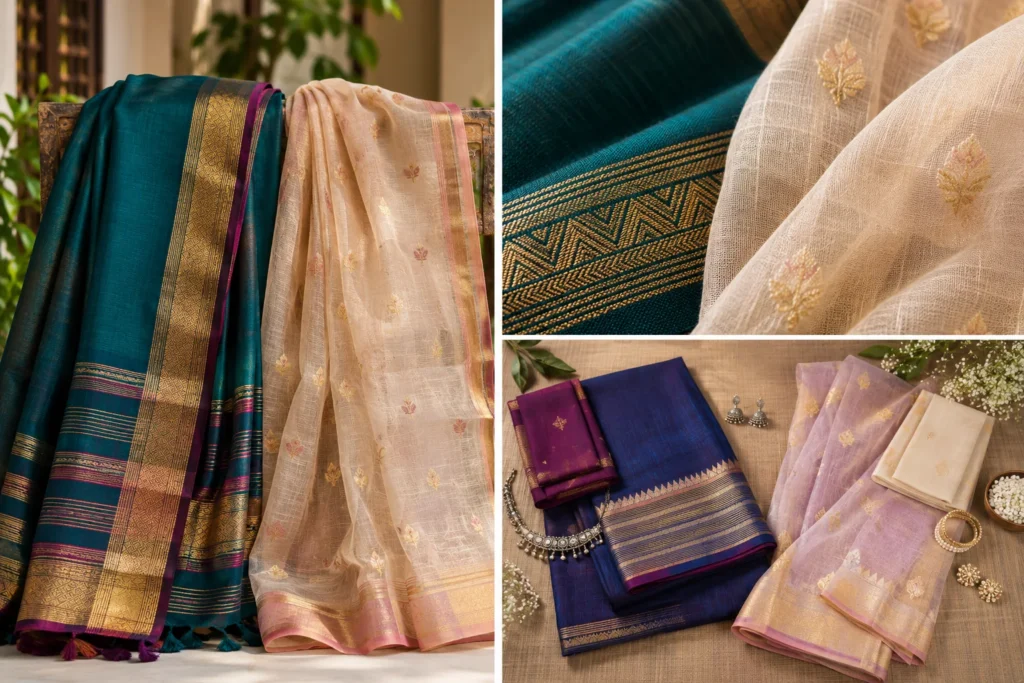
Maheshwari saree texture
Traditional Maheshwari sarees generally have a more compact construction.
This can give the fabric a slightly firmer, more defined appearance, particularly around the pleats and borders.
Some silk-cotton varieties offer an attractive combination of crispness and softness.
Many women prefer this characteristic for a neat office look or an elegant everyday drape.
Chanderi saree texture
Chanderi sarees are especially known for their fine, airy-looking fabric.
The distinctive translucency is a major part of their visual appeal.
Despite their delicate appearance, traditional Chanderi textiles can have a slightly crisp or textured feel rather than being uniformly soft.
The fabric may create a graceful, light silhouette when draped.
Which saree is more comfortable?
There is no universal winner.
For regular office wear, you may prefer the structure of a cotton or silk-cotton Maheshwari saree.
For daytime celebrations, a lightweight Chanderi saree can look especially elegant.
Comfort depends on the yarn, weave, weather, lining or petticoat, and personal preferences.
For summer, breathable cotton-based options in either tradition may be suitable.
4. Maheshwari vs Chanderi Designs: Borders, Pallus and Motifs
The most visible differences between these sarees often appear in their decorative details.
Traditional Maheshwari border designs
Maheshwari weaving is particularly associated with geometric patterns and ornamental borders.
Traditional designs include chatai (mat-inspired pattern), heera (diamond), rui phool (cotton flower) and leheriya (wave-like pattern).
A notable characteristic is the reversible border, traditionally called bugdi.
Another recognisable element is the striped pallu. Heritage examples frequently include a distinctive arrangement of five stripes.
These features contribute to the structured and balanced appearance of traditional Maheshwari sarees.
Chanderi saree motifs and zari work
Chanderi sarees are admired for delicate decorative motifs, often called buttis.
Common designs include floral patterns, peacocks, coins and lotus-inspired forms.
Gold or silver zari may be used to introduce subtle richness.
Rather than relying mainly on border geometry, Chanderi designs may distribute small motifs across the body.
This creates a more delicate ornamental appearance.
How to recognise the difference visually
When comparing Maheshwari vs Chanderi saree designs, look first at the body and border.
A relatively plain or checked body with a pronounced geometric border and striped pallu suggests traditional Maheshwari styling.
A fine, translucent fabric with small, regularly arranged decorative buttis suggests traditional Chanderi styling.
These characteristics are useful clues, but they cannot independently prove the origin or authenticity of a saree.
The traditional motifs and designs are also described by Madhya Pradesh Tourism. Madhya Pradesh Tourism+1
5. Maheshwari vs Chanderi Saree: Which Is Better for Different Occasions?
A common shopping question is whether Maheshwari or Chanderi is better for weddings, office wear and festivals.
Both can work beautifully, but their characteristic appearances lend themselves to somewhat different styling choices.
Best saree for office wear
For professional settings, a cotton or silk-cotton Maheshwari saree can be an excellent choice.
Its geometric borders and relatively restrained designs often create a polished appearance without looking excessively formal.
Try a navy blue Maheshwari saree with a contrasting border, a plain blouse and simple silver earrings.
A subtle cotton Chanderi saree can also work for office wear, especially when you prefer a lighter-looking outfit.
Best saree for weddings and festivals
For Diwali celebrations, weddings and family functions, Chanderi silk and silk-cotton sarees are popular choices.
Their fine texture, elegant zari detailing and decorative motifs can create a graceful festive look.
Pastel Chanderi sarees are particularly attractive for daytime occasions, while deeper colours can look beautiful for evening celebrations.
However, a silk-rich Maheshwari saree with a decorative zari border can be equally suitable for a wedding or traditional family function.
Best saree for daily wear
For everyday use, look beyond the weaving name and focus on practical details.
Choose a washable fabric, manageable weight and comfortable drape.
Many cotton Maheshwari sarees work well for regular wear, particularly if you like defined pleats.
Cotton Chanderi sarees may also be comfortable, although very fine or delicate varieties may require more careful handling.
Which saree is better for summer?
Both can be suitable for summer, especially in lightweight cotton or silk-cotton compositions.
If you prefer a more translucent, airy-looking fabric, Chanderi may appeal to you.
If you prefer a slightly more structured saree with defined borders, consider Maheshwari.
Neither weaving name guarantees better breathability. Fibre composition and fabric construction matter more.
6. Maheshwari vs Chanderi Saree Price: What Affects the Cost?
Price is another consideration when choosing between these two Indian handloom sarees.
It is difficult to say that Maheshwari is always cheaper than Chanderi, or the other way around.
Both weaving traditions offer products across different price segments.
Several factors influence the final selling price.
Fabric composition
Pure silk, silk-cotton and cotton varieties may have different production costs.
Silk-rich sarees often cost more than comparable cotton versions, although craftsmanship and design complexity can change this relationship.
Handloom versus powerloom
Genuine handwoven sarees involve skilled manual weaving.
The time required varies with the fabric and complexity of the design.
Powerloom-made sarees may be available at lower prices, but buyers should not assume that a low price automatically indicates machine production.
Zari and decorative detailing
Elaborate borders, complex buttis and additional decorative work can increase production costs.
The type and quality of metallic yarn also influence the price.
Seller and retail channel
A saree purchased directly from a weaver, cooperative, boutique or large retailer may have different pricing structures.
Brand positioning, finishing, packaging, overheads and retail margins all affect the price.
Buying tip: Rather than comparing two sarees only by price, compare their fibre content, weaving method, craftsmanship, finishing and seller credibility.
7. How to Identify an Original Maheshwari or Chanderi Saree
Knowing the difference between Maheshwari and Chanderi designs is useful, but identifying a genuine handloom saree requires careful shopping.
Here are the most practical checks.
Check the fabric and weave
Maheshwari sarees generally feature a comparatively compact weave, while traditional Chanderi sarees tend to have a lighter and more translucent appearance.
Nevertheless, texture alone cannot confirm authenticity.
Examine the border and pallu
For Maheshwari, look for geometric borders, traditional stripes and other characteristic woven designs.
For Chanderi, pay attention to fine buttis, decorative zari work and the fabric’s delicate appearance.
Ask about the weaving location
A genuine regional textile should have a credible connection to its traditional production area.
Ask the seller about the weaving centre, manufacturer or artisan group.
Both Chanderi Sarees and Maheshwar Sarees & Fabrics have registered Geographical Indications in India.
However, a GI registration does not automatically authenticate every product sold under those names. Intellectual Property India+1
Look for trustworthy handloom information
When a retailer advertises a handloom product, ask for supporting details.
India’s Handloom Mark and India Handloom Brand programmes can provide useful references, where applicable.
Also check whether the product description clearly specifies handloom or powerloom production.
Be careful with online product descriptions
When shopping for a Maheshwari vs Chanderi saree online, examine close-up photographs and review the seller’s specifications.
Check whether the description includes fibre composition, saree dimensions, blouse-piece details, care instructions and return conditions.
Avoid assuming a saree is pure silk simply because the listing contains the word silk.
How to Style Maheshwari and Chanderi Sarees
One of the best things about these two weaving traditions is their styling versatility.
You can create elegant looks without relying on heavy accessories.
Blouse ideas for Maheshwari sarees
A contrasting cotton blouse can highlight the distinctive border.
For formal occasions, a fitted silk blouse or boat-neck design can create a sophisticated appearance.
Deep maroon, emerald green, mustard and navy are attractive choices when coordinated with the saree’s colour palette.
Blouse ideas for Chanderi sarees
A plain silk blouse can balance a Chanderi saree decorated with small motifs.
For a festive outfit, consider a blouse with subtle zari detailing.
If the saree is translucent, select a blouse and petticoat combination that provides your preferred level of coverage.
Jewellery and footwear
Oxidised silver jewellery can complement the understated appearance of a cotton Maheshwari saree.
For festive Chanderi outfits, delicate gold-toned earrings, pearl jewellery or traditional jhumkas can work beautifully.
Comfortable sandals, block heels or traditional juttis can complete either look.
The best accessories are those that complement the fabric instead of overpowering its woven details.
How to Wash and Store Maheshwari and Chanderi Sarees
Proper care helps preserve the appearance of traditional woven textiles.
Since both weaving traditions use different fabric compositions, washing instructions should be based on the individual saree rather than its name.
For delicate silk-rich and zari-heavy sarees, professional dry cleaning is often the safer option unless the manufacturer recommends otherwise.
For washable cotton varieties, use a mild detergent, avoid vigorous rubbing and dry the fabric in the shade.
Do not wring delicate sarees or use high ironing temperatures without checking the care label.
Store clean, completely dry sarees in breathable fabric covers and protect them from prolonged sunlight and damp conditions.
Frequently Asked Questions About Maheshwari vs Chanderi Sarees
1. What is the main difference between Maheshwari and Chanderi sarees?
Maheshwari sarees generally have a more compact weave, geometric borders and striped pallus. Chanderi sarees are typically finer and more translucent, with delicate motifs and zari detailing.
2. Which is more expensive, Maheshwari or Chanderi?
Neither is consistently more expensive. Prices depend on silk or cotton content, handloom production, design complexity, craftsmanship and retail margins.
3. Is a Chanderi saree pure silk?
Not necessarily. Chanderi sarees are made in silk, cotton, silk-cotton and other variations. Check the seller’s fabric specifications before buying.
4. Is a Maheshwari saree good for office wear?
Yes. Cotton and silk-cotton Maheshwari sarees can be excellent choices for office wear because of their graceful drape and relatively restrained designs.
5. Which saree is lighter, Maheshwari or Chanderi?
Traditional Chanderi sarees are generally lighter and more translucent than comparable Maheshwari constructions. However, the weight of individual sarees varies.
6. Which is better for weddings: Maheshwari or Chanderi?
Both are suitable. Choose Chanderi for a delicate, often more translucent festive appearance, or Maheshwari for a structured look with distinctive borders. Silk-rich versions of either can suit wedding celebrations.
7. How can I identify an original Chanderi saree?
Look for fine fabric, characteristic motifs and credible information about the weaving origin. For reliable identification, seek documentation supporting the product’s regional and handloom claims.
8. Are Maheshwari and Chanderi sarees handloom products?
Both originate from traditional handloom weaving industries. However, products marketed under these names may include machine-made or inspired versions. Verify how the particular saree was manufactured.
9. Can Chanderi sarees be worn in summer?
Yes. Lightweight cotton and silk-cotton Chanderi sarees can be comfortable in summer, depending on the fabric and weather conditions.
10. Which saree is easier to drape?
A relatively compact Maheshwari saree may be easier for someone who prefers firm, defined pleats. A lightweight Chanderi may feel comfortable but can require careful handling, especially in delicate constructions.
Final Verdict: Maheshwari or Chanderi — Which Should You Buy?
When it comes to Maheshwari vs Chanderi saree, there is no single winner.
Both represent celebrated Indian weaving traditions, and both offer beautiful options for women who appreciate traditional textiles.
Choose a Maheshwari saree if you prefer geometric borders, defined pleats, a comparatively structured texture and understated elegance.
Choose a Chanderi saree if you enjoy a fine, often translucent fabric, delicate decorative motifs and a graceful festive appearance.
If possible, examine both sarees in person before purchasing. Compare their feel, fall, transparency and finishing.
Most importantly, buy from trustworthy sellers who provide clear information about the fabric composition, weaving technique and product origin.
Whether you choose Maheshwari or Chanderi, a thoughtfully selected saree can become a versatile and cherished addition to your ethnic wardrobe.
See Also
- Chanderi Handloom – Madhya Pradesh Govt, District Handloom Office, Ashoknagar
- Geographical Indications Registry – Maheshwar Sarees & Fabrics
- Maheshwari Saree Features: Fabric, Borders, Motifs and How to Identify an Original
- How the Royal Courts of Thanjavur Shaped the Modern Kanjeevaram Border
- The Queen of Silks: Behind the Magic of Pure Kanjivaram Silk Sarees
- Kota Doria vs Chanderi: Which Fabric Is Better for Summer?